
Windows Sandboxing Is 10x Harder Than Linux
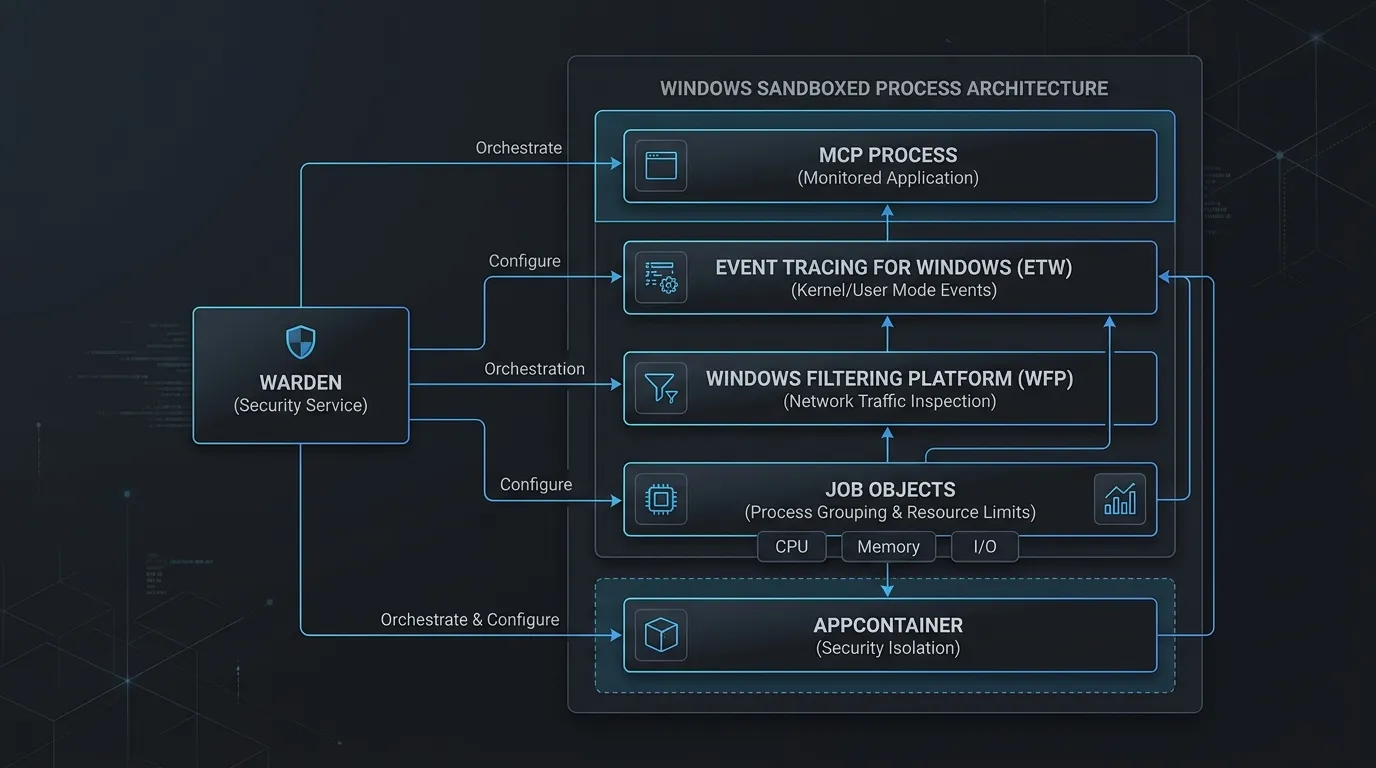
On Linux, sandboxing an MCP server took days. Bubblewrap does nearly everything: unprivileged user namespaces, bind mounts for granted paths, a network namespace with no external route. One tool, one model.
On Windows, the same guarantee needs four OS primitives working together: AppContainer tokens for filesystem capabilities, WFP filters for egress, ETW for the audit trail, and Job Objects for memory and timeout limits. Each one is a potential failure point. Two of them failed — and both were caught only because CI ran on a real Windows machine.
Bug 1: ETW bound to the wrong DLL
The ETW consumer procs (OpenTraceW, ProcessTrace, CloseTrace) were bound to kernel32.dll. On modern Windows those functions live in advapi32.dll. The test run panicked on the first real CI job. The fix was a three-line move — but cross-compiling from Linux would never have caught it, because the binding only resolves at load time on Windows.
Bug 2: WFP bound to an absent DLL
FwpmEngineOpen was bound to fwpuclnt.dll — which wasn't even present on the GitHub Windows runner image. The fix probes fwpuclnt.dll first, then falls back to iphlpapi.dll (same symbols), and fails closed if neither loads. Again: invisible until real hardware ran the code.
The pattern behind both bugs
Both bugs share a shape: the code was plausibly correct on the developer's machine and actually broken on the target. The only thing that caught them was a CI job executing escape and ETW tests on a real runner — the Windows job is now the authoritative cross-machine verification for the project.
That generalizes beyond Warden: if your cross-platform tool doesn't test on real OS runners, you don't actually support that OS. You support the fantasy of that OS.
What the Windows backend looks like now
- AppContainer token (LowBox): denies filesystem, network, and environment access by default. The token is the hard boundary — no syscall crosses it.
- WFP egress filters: only the loopback proxy bridge is permitted outbound. DNS is denied by the token; TCP is denied by the filters.
- ETW audit trail: a private real-time trace session captures kernel file I/O scoped to the sandbox tree.
- Job Objects: wall-clock timeout, memory cap, kill-on-close — a runaway process dies with its entire tree.
Each layer requires its primitives to initialize, or the run is refused. That refusal is the feature: when the AppContainer backend can't initialize without admin rights, Warden exits instead of running your server unprotected.
The lesson for tool builders
Test portability bit too: fixtures assuming POSIX paths and Linux $PATH failed on Windows for reasons that had nothing to do with the sandbox. OS-aware fixtures, real runners, and fail-closed defaults — in that order — are what make a cross-platform security claim believable.
The full story, with exact error messages and fixes, lives in REMAINING_WORK.md in the repo. If you're building cross-platform sandboxing, start there before you bind your first DLL.
Written by Prof-bilal Creator and maintainer of Warden.